Beyond the Great Loop ~ Discovering Europe by Water
If you’re a Great Looper, imagine casting off one spring morning and pointing your bow toward another country.
Not another state. Another country.
You might start in the Netherlands, cross into Belgium a few days later and eventually find yourself cruising through France. Along the way you could pass working windmills, medieval city centres, enormous commercial ports, tiny villages, vineyards, and castles — all without taking your boat to sea.
Welcome to boating on the inland waterways of Europe.
And there’s a boating community over here that may feel surprisingly familiar to members of the AGLCA: DBA – The Barge Association.
It Started With Dutch Barges
The DBA began in Britain in 1992 as the Dutch Barge Association, created by a small group of people who owned, or were interested in, traditional Dutch barges.
The name made perfect sense at the time.
For generations, the Netherlands had depended on boats to move goods through its extraordinary network of rivers and canals. Thousands of commercial barges carried grain, coal, building materials and just about everything else.
As older vessels were retired from commercial service, some found a very different second life. People began converting them into cruising boats and floating homes.
These weren’t small boats. Many of the early DBA barges were between 18 and 38 metres — roughly 60 to 125 feet — and simply too large for much of Britain’s famous narrow canal network.
So their owners looked across the Channel.
What they found was one of the most interesting cruising grounds in the world.
The Netherlands: A Country Built Around Water
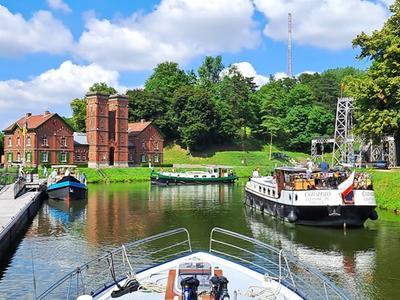
For a North American boater, arriving in the Netherlands can be a revelation.
Water isn’t just something surrounding Dutch towns. It runs right through them.
Canals and rivers are woven into everyday life. Bridges open for boats, bicycle paths follow the waterways, houses face the water and restaurants spill onto the quays. Boats of every imaginable size and description seem to be going somewhere.
You can cruise through the centre of a centuries-old town, tie up, and within minutes be walking to a bakery, café, or market.
And the variety is remarkable.
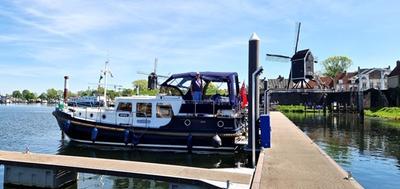
There are huge rivers and busy commercial waterways where a pleasure boat may share a lock with working barges carrying thousands of tonnes of cargo. There are lakes, small canals, and lovely old towns connected by waterways that have been in use for centuries.
For those of us cruising traditional Dutch barges, there’s something else rather special about it.
Our boats are coming home.
Belgium Is Much More Than a Shortcut to France
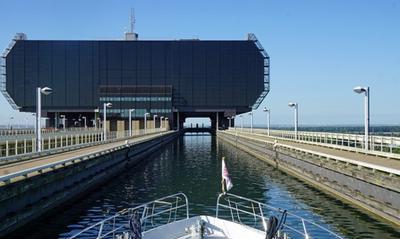
Approaching the Strépy-Thieu boat lift in Belgium — a reminder of the scale of Europe’s inland waterway infrastructure.
Belgium sometimes gets treated as the bit of water between the Netherlands and France.
It deserves much better than that.
Belgian waterways take you through some wonderful historic cities. Bruges and Ghent aren’t places where you leave the boat behind and take a tour bus into town; the waterways are part of the cities themselves.
Then the scenery — and the boating — can change completely.
Belgium still has a serious commercial waterway network. The locks can be enormous, the infrastructure impressive, and the freight traffic is a constant reminder that these waterways weren’t preserved simply for pleasure boats. They are still very much working transportation routes.
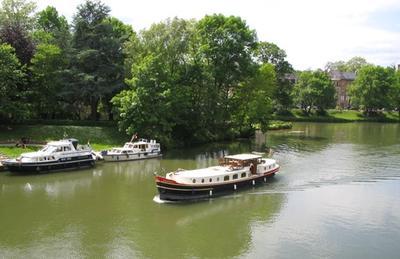
One day you can be cruising past medieval buildings and church towers. The next you’re waiting for a lock with a commercial barge several times your size.
It keeps things interesting.
And Then There’s France
Cross into France and the rhythm changes again.
There are the great rivers — the Seine, Rhône and Saône — but also hundreds of kilometres of smaller canals winding through villages, farmland, vineyards and countryside.
You can cruise your own boat right through the heart of Paris.
You can also spend days travelling slowly through rural France, stopping in towns most international visitors would probably never discover.
Some days the distance travelled is almost embarrassingly small.
But that’s rather the point.
We aren’t trying to get anywhere quickly. The waterway is the journey.
There Isn’t Just One Loop
Perhaps the biggest difference for an American Looper is that Europe doesn’t have one defining route.
There are choices. Lots of them.
The interconnected waterways of the Netherlands, Belgium, France, Germany and beyond allow boaters to create their own loops, change their minds along the way, spend a winter somewhere interesting and set off the following spring in an entirely different direction.
Of course, all those choices create questions.
- Where can we moor tonight?
- Will we fit under that bridge?
- Is there enough water?
- Where can we get fuel?
- Is the lock operating?
And the question every cruiser eventually learns to ask:
- Has anyone actually been through there lately?
That’s where the DBA becomes invaluable.
The Boat Ahead Knows Something You Don’t
The DBA has built up an enormous amount of practical information about cruising the European waterways.
Its Waterways Guide is maintained by members and covers moorings and facilities throughout the network. Someone discovers that a water point no longer works, a mooring has disappeared or a harbour has changed its arrangements, and that information can be passed along to the next boat.
The DBA Forum is another remarkable pool of collective experience.
Questions range from routes and regulations to engines, electrical systems, winter moorings, and the paperwork involved in taking a boat through different European countries.
Sometimes you don’t need an expert.
You just need someone who went through that lock yesterday.
I suspect every Looper understands the value of that.
A Community Built by Boaters
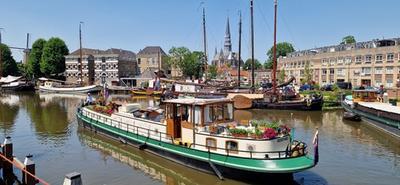
DBA rallies bring together boats, crews and a remarkable amount of shared experience.
As the organization grew, the original name eventually became too restrictive. Not every member owned a Dutch barge, not every boat was old, and members increasingly came from well beyond Britain and the Netherlands.
Today it is simply DBA – The Barge Association, with roughly 1,100 members from around the world.
Some live aboard full time. Others cruise for a few months each year. Some own converted commercial vessels more than a century old, while others cruise modern purpose-built barges and motor vessels.
And some don’t own a boat at all.
They’re still thinking about it.
Like many non-profit boating organizations, the DBA is run by volunteers — our own members giving their time and experience to help other boaters. Members maintain the Waterways Guide, contribute to the Forum and Blue Flag, organize rallies and gatherings, follow regulatory and navigation issues and represent recreational boaters with authorities across Europe.
But some of the best parts aren’t organized at all.
You spot a DBA burgee on a boat at the next mooring and wander over to say hello. Someone you’ve known only through the Forum suddenly has a face. You meet at a rally, and weeks later unexpectedly find yourselves sharing a lock somewhere in Belgium.
Cruising friendships have a habit of developing quickly.
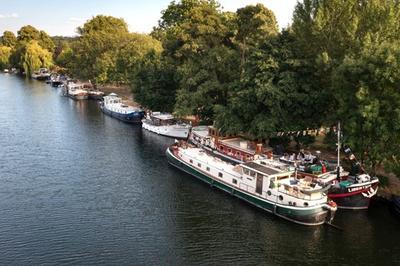
During a season, boats travelling in roughly the same direction often cross paths again and again. Someone ahead sends back information about a difficult mooring. Someone knows where to find a mechanic. Another has the obscure fitting you’ve been trying to locate for a week.
And sometimes the assistance consists of nothing more complicated than helping with a line and opening a bottle of wine afterwards.
Making the Leap
We’re part of the North American contingent.
We’re Canadian, and our current boat, Bisou Bisou, is a 23-metre Luxemotor. Cruising has taken us through the Netherlands, Belgium and France, sometimes on quiet canals and sometimes alongside very serious commercial traffic.
We’ve discovered that the DBA is part cruising guide, part technical library, and part community.
There’s almost always somebody who knows the waterway you’re considering, has dealt with the regulation you don’t understand or has already discovered that the lovely-looking mooring on the chart isn’t quite as lovely as advertised.
More importantly, there are people who understand why you want to keep going around the next corner.
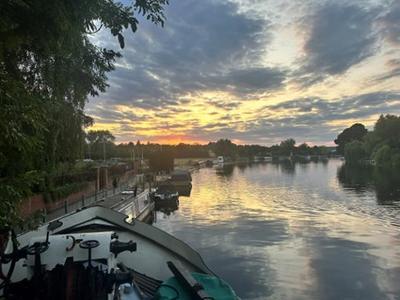
Maybe the Loop Isn’t the End
The Great Loop offers something increasingly rare: the chance to see a country slowly, from its waterways.
Europe offers that same experience, but with a twist.
Here, crossing a border may mean nothing more dramatic than noticing that the signs have changed language. One cruising season can encompass several countries. A boat that carried freight a century ago can now carry its owners from one historic city to another.
The waterways are old, but the adventure certainly isn’t.
Perhaps that’s the real connection between the DBA and the Great Loop community. Both may begin with boats and waterways, but somewhere along the way they become about people.
People sharing what they’ve learned. People helping the boat coming along behind them. People who were strangers at yesterday’s mooring and friends by the time you cast off tomorrow morning.
So, if you finish the Great Loop one day and find yourself wondering, What could possibly come next?
You might want to look across the Atlantic.
There’s an awful lot of water over here.